What Is Central Fill Compounding for Retail Pharmacies? Complete Guide


- Definition & Overview
- Core Concepts
- How Central Fill Compounding Works
- Types of Central Fill Models
- Best Practices
- Advanced Strategies
- Tools & Resources
- Frequently Asked Questions
- Key Takeaways
Definition & Overview
Central fill compounding is a pharmacy service model in which retail pharmacies outsource the preparation of patient-specific compounded medications to a licensed centralized facility. These facilities specialize in preparing, verifying, and packaging custom medications, which are then returned to the originating retail pharmacy for final dispensing to the patient.
Central fill compounding is not the same as traditional in-house compounding, where each retail pharmacy prepares every prescription on-site. Instead, central fill allows pharmacies to expand their compounding offerings without building specialized facilities, hiring additional staff, or managing complex compliance requirements.
Mega Aid Compounding Pharmacy is one such central fill partner – a PCAB-accredited and USP 795 / 800 compliant facility based in Brooklyn, NY, serving independent retail pharmacies, and regional pharmacy groups. Pharmacies that partner with Mega Aid can dispense a broad catalog of compounded medications without any lab investment.

Get started as a central fill partner
If you are a retail pharmacy interested in Central Fill Compounding outsourcing - submit a request
Submit requestCore Concepts
What is Central Fill Compounding?
Central fill compounding is the offsite preparation of compounded medications by a third-party, state-licensed pharmacy facility. These facilities receive prescription orders from retail (or “originating”) pharmacies, prepare the medications according to prescriber specifications, verify quality and safety, and ship them back for final dispensing.
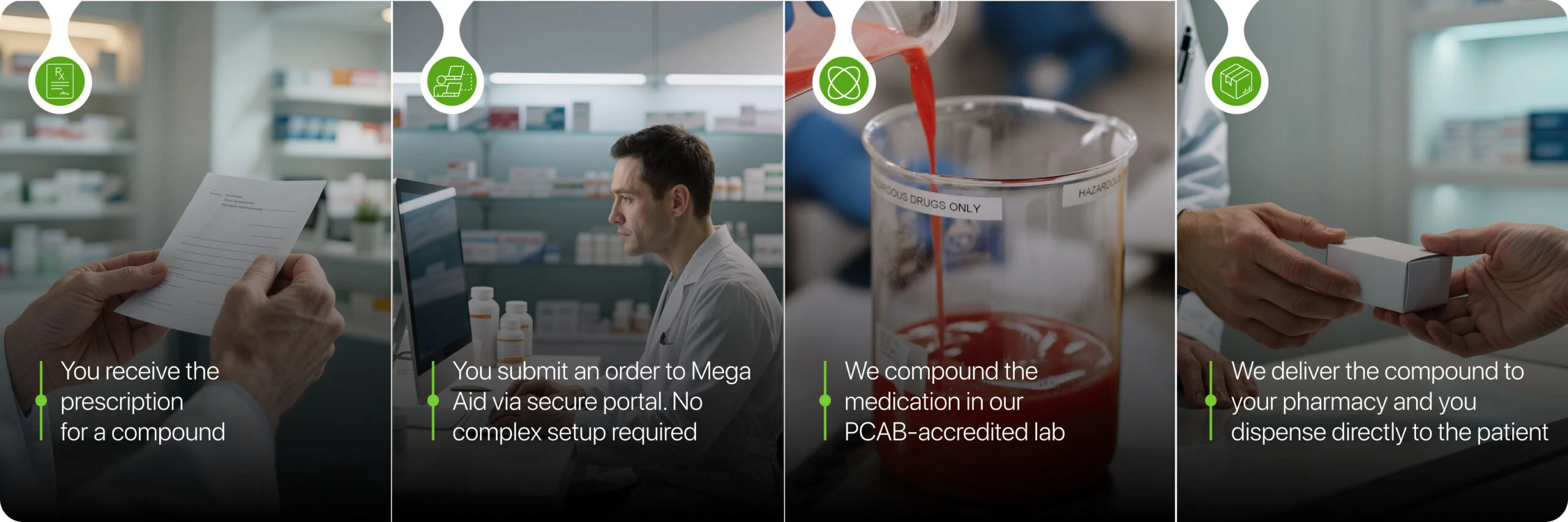
Example: A Florida retail pharmacy receives a prescription for a customized topical pain cream. Rather than turning the patient away or attempting to compound in-house, the pharmacy forwards the order to Mega Aid via a secure portal. Mega Aid compounds, verifies, and labels the medication, returning it overnight to the Florida retail pharmacy for patient pickup with no lab overhead on the retail side.
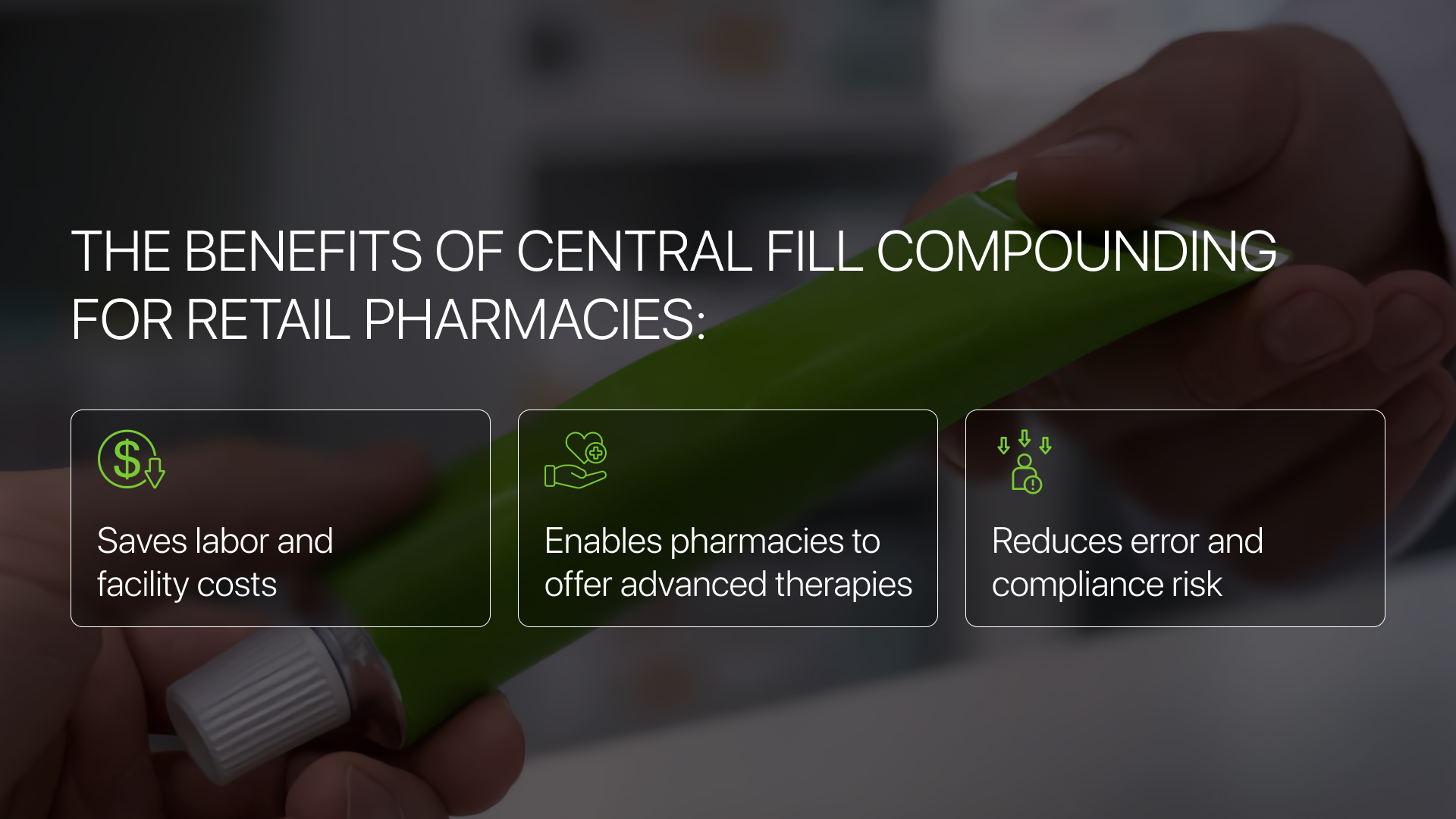
Benefits for Retail Pharmacies:
The Role of Retail Pharmacies
Retail pharmacies act as the point of care for patients, maintaining direct clinical relationships and responsibility for patient counseling. Central fill supports retail pharmacies by providing the technical backbone for compounding. With a partner like Mega Aid handling preparation and QA, retail pharmacists can focus entirely on patient care, counseling, and revenue growth — not lab operations.
Regulatory and Compliance Foundations
All central fill compounding must adhere to:
- State Board of Pharmacy regulations
- USP <795>, <797>, and <800> standards
- FDA guidance (e.g., 503A)
- PCAB or other accreditation standards
Common misconception: Central fill does not remove compliance responsibility from the retail pharmacy. It ensures that compounding is performed by specialists in a compliant environment. Mega Aid holds PCAB accreditation and operates in full compliance with USP <795> and <800> standards, with complete batch records and documentation available to support each partner pharmacy’s own compliance requirements.
Technology & Automation in Central Fill
Modern central fill facilities use:
- Automated compounding equipment
- Secure electronic prescription transmission
- Barcode and chain-of-custody tracking
- Integrated workflow management systems
Mega Aid’s platform integrates with retail pharmacy workflows through a secure portal, enabling seamless order submission, status tracking, and outcome reporting — making the handoff between retail and central fill as frictionless as possible.
The Hub-and-Spoke Model
Central fill operates as a “hub” (the compounding facility) serving multiple “spoke” (retail) pharmacies. Mega Aid functions as that hub for its pharmacy partners – one centralized, accredited operation that scales with each partner’s volume, whether they’re filling a handful of compounds per month or hundreds.
Patient and Provider Integration
Seamless communication between the provider, patient, and both pharmacies is essential. Mega Aid supports this through secure portals, integrated software, and clinical programs like MTM, ensuring continuity of care across the entire prescription lifecycle.

How Central Fill Compounding Works
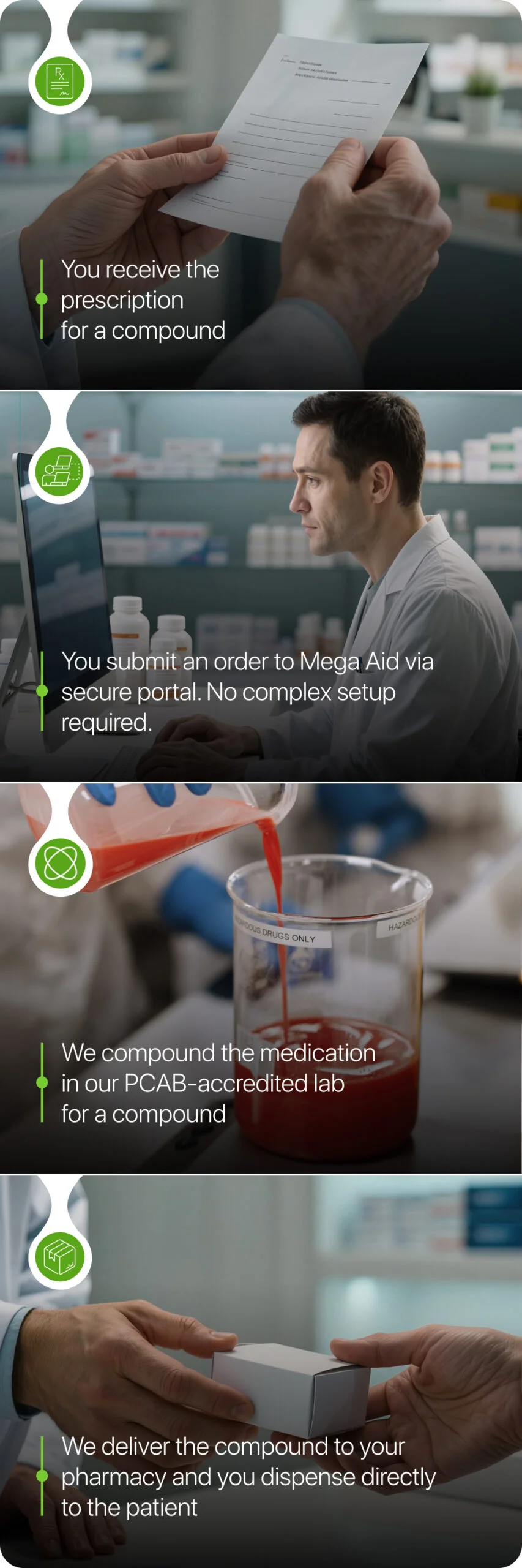
Step-by-Step Process:
Example: A patient with diabetic neuropathy receives a compounded topical cream — prepared at Mega Aid’s Brooklyn facility and dispensed at their neighborhood pharmacy within 24–48 hours, without the retail pharmacist ever needing a lab.
See exactly how the process works: View the Mega Aid Central Fill workflow →
Best Practices
1. Choose Accredited Partners
Select central fill facilities with PCAB, ACHC, and/or state board accreditation. Mega Aid holds both PCAB and ACHC accreditation and operates under USP <795>/<800> and HIPAA standards – a baseline every retail partner should require.
Common Mistake: Prioritizing price over accreditation can lead to compliance violations and patient safety risks.
2. Implement Secure, Integrated Technology
Use e-prescribing and integrated pharmacy management systems for accuracy, data security, and real-time tracking. Mega Aid’s secure portal handles this end-to-end, reducing manual steps and documentation errors.
3. Maintain Strong Clinical Oversight
Pharmacists should review every compounded medication before and after central fill processing. Document all steps. Mega Aid maintains complete batch records and makes documentation available to each partner for audit readiness.
4. Educate Patients and Providers
Communicate the process, timelines, and benefits to both prescribers and patients proactively. Mega Aid supports this with clinical resources and outcome reporting that pharmacies can share with their prescriber networks.
5. Start with High-Value, High-Volume Compounds
Begin your central fill program with the most common or high-impact compounded therapies. Mega Aid offers formulations across pain management, dermatology, nail fungus, hair restoration, hemorrhoids, LDN, and more – a ready-made portfolio to start with.
6. Review Your Workflow Regularly
Central fill is not “set and forget.” Schedule regular audits and process reviews. Mega Aid’s team works with pharmacy partners to optimize the workflow as volume and therapy mix evolve.
Get started as a central fill partner
If you are a retail pharmacy interested in Central Fill Compounding outsourcing - submit a request
Submit requestAdvanced Strategies
Scaling Central Fill Across Multiple Locations
Integrate order management to automate routing and reporting across locations. Mega Aid supports both independent single-location pharmacies and regional pharmacy groups scaling across multiple sites with flexible volume and no minimum requirements.
Leveraging Data Analytics
Use centralized data for predictive inventory, trend analysis, and prescriber engagement. As your partnership with Mega Aid matures, outcome data from compounded therapies becomes a powerful tool for prescriber relationship-building.
Navigating Regulatory Complexity
Stay current with evolving USP, FDA, and state regulations. Mega Aid’s compliance infrastructure does the heavy lifting, but retail partners should still engage compliance consultants for periodic internal audits.
Frequently Asked Questions
Q1: What is the main benefit of central fill compounding for retail pharmacies?
It enables pharmacies to offer a broader range of customized therapies with no additional labor, overhead, and compliance risk. Partners like Mega Aid handle the compounding infrastructure entirely, so retail pharmacies keep the patient relationship and the revenue without the capital cost.
Q2: Does central fill mean the pharmacy no longer interacts with patients?
No. The retail pharmacy remains responsible for patient counseling and final dispensing. Mega Aid works in the background, and the patient’s relationship stays with their local pharmacy.
Q3: How long does a central fill prescription typically take with Mega Aid?
Most prescriptions go through Mega Aid’s workflow with 1–2 business day turnaround, with overnight shipping to the retail pharmacy in most cases.
Q4: What regulations apply to central fill compounding?
All standard pharmacy, compounding, and Board of Pharmacy regulations apply, including USP <795>/<800> and state laws. Mega Aid holds PCAB accreditation and maintains full compliance documentation for every compound.
Q5: How does Mega Aid ensure quality and safety?
Through multi-tiered verification, USP-quality chemical ingredients, strict employee qualification standards, calibrated equipment, and comprehensive batch record documentation – available to retail partners on request.
Q6: Is central fill cost-effective for small pharmacies?
Yes. Mega Aid has no minimum volume requirement, which means independent and small-volume pharmacies can access the same compounding capabilities as large chains without capital investment.
Q7: What are the common pitfalls to avoid with central fill?
Choosing the cheapest provider without accreditation, poor communication, and failing to maintain oversight. Mega Aid’s onboarding process is designed to address each of these from day one.
Q8: How do I start offering compounded medications through Mega Aid?
The onboarding process is straightforward: licensing review, aligning on formulations, and integrating with your order workflow. There’s no lab buildout and no upfront investment. Submit a request on the Mega Aid central fill page to connect with the business development team.
- Central fill compounding allows retail pharmacies to expand their capabilities, reduce costs, and improve the quality of care without building or maintaining a lab.
- Choosing an accredited, compliant partner is the most important decision. Mega Aid’s PCAB accreditation, USP compliance, and HIPAA verification provide a strong foundation.
- Retail pharmacies maintain full patient relationships and clinical responsibility, the central fill partner works in the background.
- Central fill is scalable: Mega Aid supports everything from single independent pharmacies to regional pharmacy groups and telehealth platforms.
- Start with high-impact compound categories: pain, dermatology, LDN, and expand as you gain experience with the model.
Central Fill Solutions
- Mega Aid Central Fill Services: PCAB-accredited central fill for retail pharmacies and telehealth companies, with MTM integration and outcome reporting
- PCAB — Pharmacy Compounding Accreditation Board: Accreditation standards
Learning Resources
- Mega Aid Insights: Educational articles and clinical updates for pharmacists and providers
- USP Compounding Chapters: <795>, <797>, <800> guidelines
Communities & Conferences
Further Reading