Are Multi-Ingredient Pain Relief Creams Effective? A Comprehensive Guide



Chronic pain affects millions of individuals worldwide, limiting quality of life and daily function. As oral medications present risks of side effects and systemic complications, compounded topical pain creams—often containing multiple active ingredients—have emerged as a promising alternative. But how effective are these multi-ingredient pain relief creams, and what does current research say about their safety, efficacy, and best use?
This guide, prepared by Mega Aid Compounding Pharmacy, synthesizes the latest scientific evidence, clinical insights, and expert perspectives to help patients and providers make informed decisions about topical compounded pain therapies.
- Understanding Multi-Ingredient Pain Relief Creams
- What Does the Science Say?
- Benefits and Risks
- Common Ingredients in Compounded Topical Pain Creams
- Patient Experiences & Clinical Insights
- Mega Aid’s Approach: Personalized Pain Management
- Resources & References
Understanding Multi‑Ingredient Pain Relief Creams
What Are Compounded Topical Pain Creams?
Compounded topical pain creams are custom-made medications prepared by specialized pharmacies like Mega Aid. Unlike mass-produced creams, these are tailored to individual patient needs and can contain several active pharmaceutical ingredients (APIs) designed to target multiple pain pathways simultaneously.
How They Work:
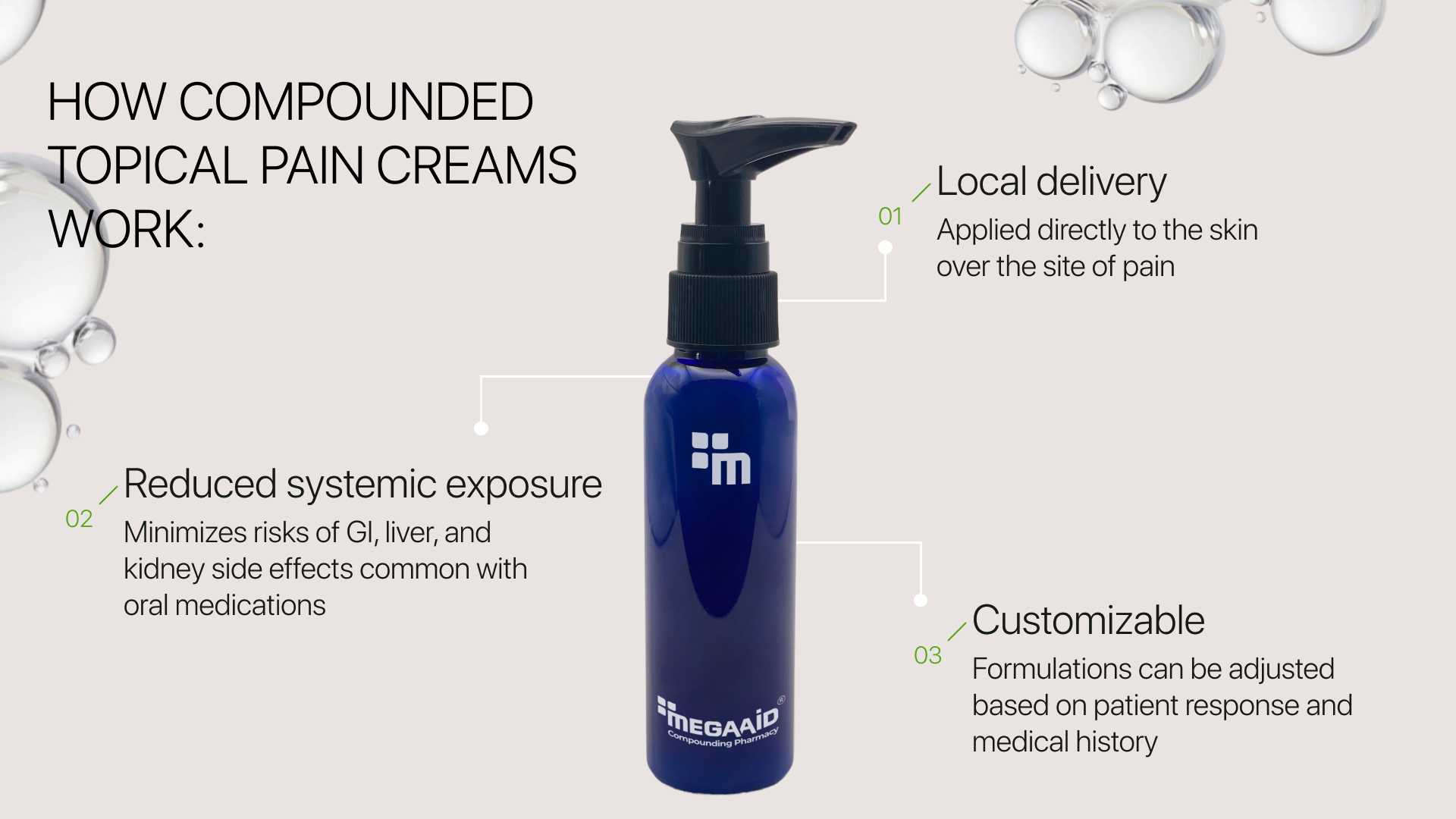
Typical Forms:
- Creams
- Gels
- Ointments
- Lotions
Why Mix Multiple Active Ingredients?
Pain is complex and may involve inflammation, nerve dysfunction, and muscle spasm. By combining drugs with different mechanisms (e.g., anesthetics, anti-inflammatories, muscle relaxants), compounded creams aim to provide more comprehensive relief.
What Does the Science Say?
Key Research Findings
| Source | Main Findings |
|---|---|
| NCBI/National Academies (2020) | Limited evidence supports most multi-ingredient compounded creams. Some combinations (e.g., lidocaine, doxepin, naproxen, and pentoxifylline/clonidine) show potential, but high-quality research is lacking. Safety and efficacy can vary significantly between formulations. |
| Johns Hopkins (2019) | A rigorous study found no significant difference in pain relief between compounded multi-ingredient creams and placebo for most chronic pain conditions. Some benefit with ingredients also available in FDA-approved topicals (e.g., lidocaine, diclofenac). |
| Healthline & Cochrane Reviews | Topical analgesics may reduce pain up to 50% in some cases. Counterirritants (menthol, camphor), NSAIDs, and anesthetics are most supported by research. Combinations should be used with caution and under clinical supervision. |
Evidence Strength for Common Ingredients
- Strong evidence: Lidocaine, diclofenac/NSAIDs (for localized pain)
- Moderate evidence: Capsaicin, menthol
- Limited/uncertain: Most multi-ingredient compounded formulations
Expert Consensus
- Multi-ingredient compounded creams may be appropriate for select patients who cannot tolerate oral medications or need targeted therapy.
- More rigorous clinical trials are needed to establish the value of complex customized combinations.
Benefits and Risks
Potential Benefits
- Localized action with fewer systemic side effects
- Customizable to individual needs
- Alternative for patients who cannot tolerate oral medications
- May help reduce use of opioids or systemic drugs
Risks and Limitations
- Limited scientific evidence for most combinations
- Potential for drug–drug interactions and skin irritation
- Variable quality and oversight (not FDA-approved)
- Cost (not always covered by insurance)
Table: Pros & Cons of Multi-Ingredient Compounded Pain Creams
| Pros | Cons |
|---|---|
| Personalized formulations | Limited research for most combinations |
| Reduced systemic side effects | Potential for adverse reactions |
| Useful for special populations | Not FDA-approved |
| Can adjust based on response | Cost and insurance coverage |
Common Ingredients in Topical Pain Creams
| Ingredient | Class | Use/Mechanism | Evidence Level |
|---|---|---|---|
| Lidocaine | Local anesthetic | Numbs nerve endings | Strong |
| Diclofenac/Naproxen | NSAID | Reduces inflammation | Strong (for joints) |
| Capsaicin | Counterirritant | Depletes pain neurotransmitter | Moderate |
| Baclofen | Muscle relaxant | Reduces muscle spasms | Limited |
| Gabapentin | Anticonvulsant | Reduces neuropathic pain signals | Limited |
| Ketamine | NMDA antagonist | Blocks pain signal transmission | Limited |
| Clonidine | Alpha-2 agonist | Reduces nerve pain | Limited |
| Doxepin | Antidepressant | Reduces itching, some pain relief | Moderate |
Patient Experiences & Clinical Insights
Mega Aid Compounding Pharmacy has worked with thousands of patients and providers in New York and New Jersey. Here is what real-world experience shows:
“The benefits of being able to prescribe topical compounds to help with pain management is that I am able to reduce pain, muscle and joint stiffness. Usage of NSAIDs and sodium channel blockers such as gabapentin adversely affect liver, kidney, and mental functions in patients who take them orally. Without being able to prescribe compounds I would subject my patients to these possible side effects.”— MD, Bronx, NY
“I found the acceptance of this treatment in my practice higher than the usage of PO medication. It has helped me to reduce opioid consumption which can cause severe and adverse reactions including death from respiratory depression, which is currently a epidemic in the state of NY.”— MD, Lincoln Hospital, Bronx, NY
Healthcare providers-reported advantages:

Note: While individual reports are positive, outcomes can vary and should be monitored by your provider.
Clinical outcomes according to the Mega Aid’s medication therapy management reports:
84.2% of patients reported reduced pain levels using multi-ingredient pain relief treatments
Mega Aid’s Approach: Personalized Pain Management
Mega Aid Pharmacy specializes in:

Why Choose Mega Aid?
- Seamless collaboration with your doctor
- Lab-grade ingredients sourced from FDA-registered suppliers
- Transparent patient education and ongoing support
- Specialty compounding for arthritis, neuropathy, chronic pain, and more
Key Scientific Sources
- Compounded Topical Pain Creams: Review of Select Ingredients for Safety, Effectiveness, and Use. NCBI (2020)
- Johns Hopkins Medicine: Research Pushes Back on Benefits of Compounded Topical Pain Creams (2019)
- Cochrane Library: Topical analgesics for acute and chronic pain in adults
- Healthline: 7 Topical Pain Relief Products Reviewed
Mega Aid Patient & Provider Resources
Multi-ingredient compounded pain creams offer a personalized approach to pain management, especially for patients with unique clinical needs. However, scientific evidence supporting their effectiveness is limited, and careful oversight is necessary. Mega Aid Compounding Pharmacy is dedicated to safe, evidence-based, and patient-centered compounding, working closely with providers and patients to optimize outcomes.
This page is for informational purposes only and does not constitute medical advice. Always consult your healthcare provider for diagnosis and treatment recommendations.