Can Retail Pharmacies Outsource Compounding? Legal & Compliance Explained


- Overview
- Core Concepts
- Choosing the Right Compounding Partner: 503A vs. 503B
- Why Quality Accreditations Matter for 503A Partners
- How Outsourcing Compounding Works
- Types of Compounding & Outsourcing Models
- Best Practices for Legal & Compliance
- Advanced Compliance Considerations
- Tools & Resources
- FAQ
- Key Takeaways & Next Steps
Note: the following is not legal advice. If you are considering a shared pharmacy servies or central fill partnership, you should consult with a licensed attorney.
Overview
Common misconception
Retail pharmacies must choose between doing all compounding in-house or not offering it at all. In reality, outsourcing is a proven, legally compliant way to add compounding to your service mix without building the infrastructure yourself.
Retail pharmacies traditionally dispense commercially available drugs, but many now consider outsourcing compounding to specialized facilities to expand their service offerings. Outsourcing is subject to complex legal and compliance requirements, especially after the Drug Quality and Security Act (DQSA) of 2013 and the creation of the 503B outsourcing facility category.
What Central fill compounding outsourcing is:
The process by which a retail pharmacy contracts with a licensed compounding pharmacy or registered outsourcing facility to prepare medications that are not available commercially – either due to patient-specific needs or drug shortages.
What Central fill compounding outsourcing isn’t:
is not the same as buying finished commercial drugs; it doesn’t remove the pharmacy’s responsibility for patient safety, regulatory compliance, or quality assurance.
You will learn:
- The legal definitions and regulatory framework (503A vs. 503B)
- Which outsourcing model is the right fit for a retail pharmacy
- How quality accreditations (PCAB, USP) provide trust and third-party validation for 503A partners
- State and federal compliance requirements
- Best practices and common pitfalls
Choosing the Right Central Fill Compounding Partner: 503A vs. 503B
This is where most guides oversimplify. The reality is that both 503A compounding pharmacies and 503B outsourcing facilities are legitimate, legal partners for retail pharmacies. But they serve very different operational needs. Choosing the wrong category can mean poor service, unrealistic volume commitments, or legal complications.
503A Compounding Pharmacies – The Natural Fit for Most Retail Pharmacies
A 503A compounding pharmacy is a traditional pharmacy that compounds medications based on valid, patient-specific prescriptions and is regulated primarily by state boards of pharmacy. They must comply with applicable USP standards, including:
- USP <795> – Non-sterile compounding standards
- USP <797> – Sterile compounding standards
- USP <800> – Hazardous drug handling
For retail pharmacies, a 503A partner is typically the right choice. Here’s why:
- Prescription-based, patient-specific: Every compound is prepared for an identified individual patient – which is exactly the model retail pharmacies work in
- Flexible volumes: 503A pharmacies work with you regardless of whether you’re just beginning to offer compounded medications or have an established patient base. There are no minimum order commitments that can make the model impractical for community pharmacies
- Personalized service: 503A partners are set up for collaborative, ongoing relationships with dispensing pharmacies and prescribers, not bulk industrial accounts
- Central fill capability: A 503A pharmacy can serve as a central fill partner for retail pharmacies, preparing compounds that are then dispensed by the retail pharmacy to named patients under a valid prescription
Mega Aid’s Central Fill Pharmacy operates as a 503A partner designed specifically for retail pharmacies. Whether you’re starting to offer compounded medications for the first time or looking to scale an existing program, Mega Aid provides the flexibility, individual approach, and dedicated support that retail pharmacy workflows require.

Get started as a central fill partner
If you are a retail pharmacy interested in Central Fill Compounding outsourcing - submit a request
Submit request503B Outsourcing Facilities – A Niche Solution for High-Volume or Hospital Use
A 503B outsourcing facility is registered with the FDA and operates under Current Good Manufacturing Practices (CGMP). It’s the same standards as commercial pharmaceutical manufacturers, and is subject to regular FDA inspection. They are primarily designed to produce large batches of compounded sterile preparations for hospital and institutional use.
503B facilities may be beneficial in specific scenarios, but they are not the default answer for most retail pharmacies.
Key realities:
- Office use, not home use: The defining characteristic of a 503B facility is that it can supply medications without patient-specific prescriptions for office administration in hospitals and clinics. For retail pharmacy dispensing to individual patients, this distinction is less relevant.
- Volume minimums: 503B outsourcing facilities are built for industrial scale. They typically will not engage with partners who cannot commit to consistent, large-volume orders. For a retail pharmacy that is expanding its compounding offering or has moderate prescription volumes, a 503B facility is often simply not a viable or cost-effective partner.
- Limited flexibility: Because every process must be validated under CGMP before a new product reaches market, 503B facilities have longer lead times, less formulation flexibility, and a more rigid product catalog than 503A pharmacies.
- Best suited for: Large pharmacy chains with high, consistent sterile compounding volumes; hospital systems; ambulatory surgery centers needing ready-to-administer sterile medications.
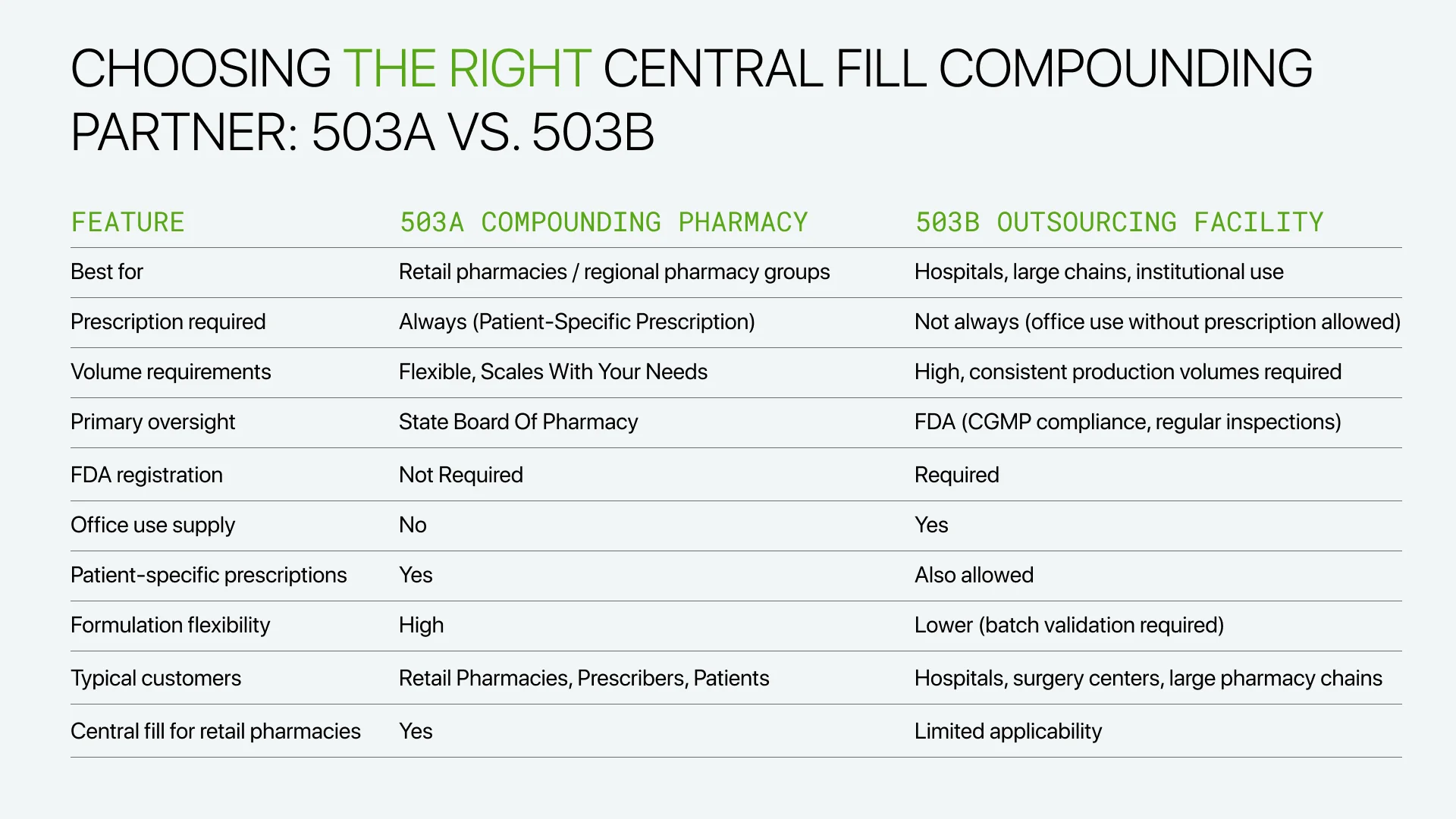
Side-by-Side Comparison
| Feature | 503A Compounding Pharmacy | 503B Outsourcing Facility |
| Best for | Retail pharmacy / Regional pharmacy groups | Hospitals, large chains, institutional |
| Prescription required | Always (patient-specific) | Not always (office use without Rx) |
| Volume requirements | Flexible, scales with your needs | High consistent volumes required |
| Primary oversight | State Board of Pharmacy | FDA (CGMP, regular inspections) and State Board of Pharmacy |
| FDA registration | Not required | Required |
| Office use supply | No | Yes |
| Patient-specific Rx | Yes | Also allowed |
| Formulation flexibility | High | Lower (requires batch validation) |
| Typical customers | Retail pharmacies, prescribers, patients | Hospitals, surgery centers, large chains |
| Central fill for retail | Yes | Limited applicability |
Bottom line for retail pharmacies:
If you’re a community or independent retail pharmacy looking to add or expand compounding services, a 503A compounding pharmacy is the appropriate, practical, and legally correct partner. 503B is relevant if you’re a large chain or health system with very high, predictable sterile compounding volumes and a need for office-use supply.
Why Quality Accreditations Matter for 503A Partners
A common concern about 503A pharmacies is the question of third-party validation. Since 503A facilities are not subject to FDA registration or CGMP requirements, how does a retail pharmacy know their partner maintains genuinely high quality standards?
The answer lies in voluntary accreditation programs and USP compliance, and they matter more than many pharmacies realize.
PCAB Accreditation (Pharmacy Compounding Accreditation Board)
PCAB is the leading national quality accreditation for compounding pharmacies, now administered through the Accreditation Commission for Health Care (ACHC). According to the National Center for Biotechnology Information (NCBI), PCAB was established to provide third-party validation that can serve as an important signal of quality for both prescribers and dispensing pharmacy partners.
Key facts about PCAB:
- PCAB accreditation requires compliance with applicable USP chapters: <795>, <800>, and/or <797> as a condition of accreditation
- An extensive on-site survey by an independent expert is required, with annual verification
- Fewer than 21% of compounding pharmacies in the United States hold PCAB accreditation, and Mega Aid Compounding Pharmacy is one of them
- The American Medical Association recommends that providers work only with PCAB-accredited compounding pharmacies
- PCAB accreditation is a significant signal of operational quality and is treated as such in pharmacy valuations and lender due diligence
When evaluating a 503A compounding partner, PCAB accreditation is one of the most meaningful indicators that the facility has been independently verified against national standards.
USP Compliance Standards
The United States Pharmacopeia (USP) sets the official quality standards for compounding pharmacies. For a 503A pharmacy, the relevant chapters are:
- USP <795> – Standards for non-sterile compounding (capsules, creams, suspensions, etc.)
- USP <797> – Standards for sterile compounding (injections, eye drops, infusions)
- USP <800> – Standards for handling hazardous drugs (used in hormone replacement therapy, fungus treatment, hair loss treatment, etc.)
State boards of pharmacy require 503A pharmacies to comply with these USP chapters, though the degree of enforcement varies by state. A compounding partner that voluntarily exceeds baseline requirements through PCAB accreditation, independent third-party batch testing, and documented USP compliance gives retail pharmacy partners the confidence that products dispensed to their patients meet consistent, professionally verified quality standards. For an example, Mega Aid routinely sends lot samples to independent third-party laboratories to confirm potency
What to Ask a Prospective 503A Partner
When evaluating a compounding partner for your retail pharmacy, ask:
- Are you PCAB-accredited? In sterile and/or non-sterile compounding?
- Do you comply with USP <795>, <800>, and/or <797>?
- Do you conduct independent third-party testing on finished preparations?
- What is your quality assurance process for batch review?
- What multi-state licensing do you hold?
- What is your process for recalls and adverse event notification?
Mega Aid’s team is available to answer these questions and walk through our quality standards as part of our pharmacy partnership process.

How Outsourcing Compounding Works
Step-by-Step Process
- Needs Assessment: Retail pharmacy identifies the need: specific formulations, patient demand, or a gap in current service offering.
- Partner Selection: Choose the right type of partner for your volume and patient model (503A for most retail pharmacies; see above).
- Contracting: Establish a written agreement specifying products, responsibilities, recall protocols, adverse event reporting, and compliance obligations.
- Order Placement: The dispensing pharmacy receives a valid patient prescription, then orders the compounded medication from the partner on a per-prescription basis.
- Product Receipt & Verification: Upon receiving, verify labeling, documentation, and quality certificates.
- Dispensing: Dispense to the named patient per the prescription.
- Documentation and Record-Keeping: Maintain full records for regulatory inspection, including ordering, receipt, and dispensing documentation.
Important: As the dispensing pharmacy, your liability does not transfer to the compounding partner. The quality, safety, and appropriateness of the preparation remains the fiduciary responsibility of the dispensing pharmacy. Choose your partner carefully and maintain your own quality oversight process.
Before and After Outsourcing
- Before: Retail pharmacy lacks compounding capability, turns away prescriptions for customized medications, or attempts in-house compounding without the proper infrastructure.
- After: Partners with a 503A central fill compounding pharmacy, enabling prescription fulfillment for compounded medications with appropriate compliance, documentation, and patient safety protocols.
Get started as a central fill partner
If you are a retail pharmacy interested in Central Fill Compounding outsourcing - submit a request
Submit requestTypes of Compounding & Outsourcing Models
Major Types of Compounding
- Non-Sterile Compounding: Creams, capsules, suspensions, troches. Lower risk, most common for retail pharmacy outsourcing.
- Sterile Compounding: Injections, eye drops, infusions. High risk, requires USP <797>-compliant facilities.
- Hazardous Drug Compounding: Drugs that are carcinogenic, teratogenic, or otherwise hazardous (e.g., some chemotherapy agents). Requires USP <800> compliance.
Outsourcing Models
- Central Fill Partnership (503A): The retail pharmacy’s most common model. A 503A partner prepares patient-specific compounds on prescription, which the retail pharmacy then dispenses. Mega Aid’s Central Fill Pharmacy is purpose-built for this relationship.
- Direct 503B Sourcing: Relevant for high-volume chains or institutional pharmacies needing bulk sterile preparations for office administration. Requires consistent large-volume commitments.
- Hybrid Models: Larger operations may use a 503A partner for patient-specific compounds and separately engage a 503B facility for specific high-volume sterile products.
Best Practices for Legal & Compliance
1. Match Your Partner Type to Your Business Model
Retail pharmacies filling patient-specific prescriptions should partner with a licensed 503A compounding pharmacy. Verify that your partner is licensed in your state and any states where your patients are located.
2. Confirm Accreditation and Quality Standards
Request documentation of PCAB accreditation, USP compliance, and third-party testing practices before entering a partnership agreement. These are the marks of a compounding partner operating at the highest professional standards.
3. Establish a Formal Written Agreement
Your contract should cover: products compounded, turnaround times, labeling requirements, recall notification protocols, adverse event reporting timelines, and shared liability provisions.
4. Maintain Comprehensive Documentation
Track all orders, receipts, QC reports, and adverse event data. This is critical for regulatory audits and inspections by your state board of pharmacy.
5. Regularly Review State Board Regulations
State laws govern compounding requirements and can be stricter than federal standards. Assign a compliance officer or subscribe to regulatory updates from your state board of pharmacy and from organizations like NABP.
6. Implement Quality Assurance on All Received Compounds
As the dispensing pharmacy, you bear final responsibility. Inspect packaging, verify certificates of analysis, and monitor for recalls. Do not assume your partner’s quality controls eliminate your own oversight obligations.
7. Train Staff on Outsourcing Protocols
Annual training and competency assessments for staff handling outsourced compounded medications reduce the risk of errors and compliance violations.
Common mistakes to avoid:
- Partnering with an unaccredited facility without verifying quality standards
- Assuming your state law matches federal law
- Inadequate record-keeping
- Failing to establish a written agreement with recall and adverse event protocols
Advanced Compliance Considerations
Navigating Multi-State Regulations
Retail pharmacies dispensing to patients in multiple states must ensure all outsourced products comply with each relevant state’s requirements. Your 503A partner must be licensed in the states where it ships compounded medications. Verify this before the first order.
Responding to Regulatory Changes
DQSA and state regulations evolve. USP chapters <795>, <797>, and <800> have undergone significant revisions in recent years. Your compliance process should include a mechanism for tracking and implementing regulatory changes as they occur.
Risk Management and Insurance
Review your pharmacy’s insurance policies to confirm coverage for compounding-related liabilities, including products compounded by a third-party partner and then dispensed by your pharmacy.
The 2012 Meningitis Outbreak: Why Vetting Matters
In 2012, contaminated steroid injections from the New England Compounding Center caused a fungal meningitis outbreak that killed 64 people and injured over 750 across 20 states. This tragedy directly led to the DQSA of 2013 and the creation of the 503B outsourcing facility category. It is also the reason that accreditation, independent testing, and rigorous partner vetting are not optional—they are the professional and legal standard for safe compounding practice.
Integration with Pharmacy Management Systems
Ensure that outsourced compounded medications and their source documentation integrate with your pharmacy management and EHR systems for full traceability and rapid recall response if needed.
FAQ
Q1: Can any retail pharmacy outsource compounding?
Yes, retail pharmacies can outsource compounding. For most retail pharmacy operations, the right partner is a licensed 503A compounding pharmacy that compounds patient-specific prescriptions. Your partner must be licensed in your state and comply with applicable USP standards.
Q2: What’s the difference between 503A and 503B?
503A pharmacies compound patient-specific medications per individual prescriptions and are regulated by state boards of pharmacy. 503B outsourcing facilities are FDA-registered, operate under CGMP, can compound large batches without prescriptions, and are primarily designed for hospital and institutional office-use supply, not retail pharmacy dispensing.
Q3: Is a prescription always required for outsourced compounded drugs?
When partnering with a 503A pharmacy, yes. Every compound requires a valid prescription for an identified individual patient. This is also the legally correct model for retail pharmacy dispensing.
Q4: Who is liable for a compounded drug made by an outsourcing facility?
Both the compounding partner and the dispensing pharmacy share liability. The dispensing pharmacy retains fiduciary responsibility for the safety and appropriateness of what it dispenses. Proper vetting, written agreements, and documentation are essential.
Q5: Do I need to use a 503B facility to ensure quality?
No. A PCAB-accredited 503A compounding pharmacy that complies with USP <795>, <800> , and/or <797> standards and conducts independent third-party testing operates at a high quality standard independently of FDA CGMP registration. PCAB accreditation and USP compliance are the key quality indicators for 503A partners.
Q6: Are there state-specific restrictions on outsourcing?
Yes. Many states have additional requirements, and your compounding partner must be licensed in each state where it ships medications. Always verify with your state board of pharmacy.
Q7: Can a 503A pharmacy serve as a central fill partner for my retail pharmacy?
Yes. A 503A compounding pharmacy can act as a central fill partner, preparing compounded medications based on individual patient prescriptions which are then dispensed by your retail pharmacy. This is the model Mega Aid’s Central Fill Pharmacy is built around.
Q8: What records must be kept when outsourcing?
All ordering, receipt, verification, and dispensing records, including certificates of analysis, lot numbers, beyond-use dates, and vendor compliance documentation.
Q9: How do I verify a 503A partner’s quality standards?
Ask for PCAB accreditation documentation, USP compliance policies, third-party testing results, and state licensing verification. A reputable 503A partner will provide this transparently.
Q10: Can outsourcing help with drug shortages?
Yes. Both 503A and 503B facilities can compound medications that are commercially unavailable due to shortages, subject to applicable FDA guidance and state regulations.
Q11: How often should compliance policies be reviewed?
At minimum annually, and whenever regulations change—including updates to USP chapters or FDA guidance on compounding.
Q12: Is Mega Aid a 503A or 503B pharmacy?
Mega Aid operates as a 503A compounding pharmacy and central fill partner, making it the appropriate partner for retail pharmacies looking to offer compounded medications to their patients on a prescription-by-prescription basis. Contact Mega Aid to discuss your pharmacy’s needs →
- FDA Outsourcing Facility Search (503B): accessdata.fda.gov – Verify if a facility is FDA-registered
- NABP PCAB Accreditation Program: nabp.pharmacy – Verify PCAB accreditation status
- State Boards of Pharmacy: For state-specific compounding requirements
- USP Compounding Standards: usp.org – Official standards for <795>, <797>, <800>
- FDA Human Drug Compounding Guidance: fda.gov/drugs/human-drug-compounding
- Mega Aid Central Fill Pharmacy: mega-aid.com/central-fill-pharmacy – 503A central fill partner for retail pharmacies
- Mega Aid for Healthcare Providers: mega-aid.com/for-healthcare-providers – Partnership and collaboration resources
- ASHP Guidelines on Outsourcing Sterile Compounding – link
- FDA: FD&C Act Provisions Applying to Human Drug Compounding – fda.gov
- Pharmacy Times: Regulatory Considerations for 503B to 503A Model – pharmacytimes.com
- Retail pharmacies can outsource compounding, and for most community and independent retail pharmacies, the right partner is a licensed 503A compounding pharmacy, not a 503B outsourcing facility.
- 503B facilities serve hospitals and large health systems with high, consistent sterile compounding volumes. They are not typically accessible to or appropriate for community retail pharmacies.
- Quality in a 503A partner is validated through PCAB accreditation, USP compliance (<795>, <797>, <800>), and independent third-party testing, not through FDA registration alone.
- Maintain comprehensive records, establish written agreements with your compounding partner, and stay current on both federal and state regulations.
- The dispensing pharmacy retains final responsibility for patient safety regardless of who prepared the compound.
For retail pharmacies exploring compounding outsourcing:
- Review your state board of pharmacy’s requirements for receiving compounded medications
- Evaluate prospective partners on PCAB accreditation, USP compliance, and multi-state licensing
- Contact Mega Aid’s Central Fill Pharmacy to discuss how our 503A compounding model can work for your pharmacy’s patient population and volume
Internal Links