Central Fill Compounding vs White-Label Pharmacy Fulfillment: What’s the Difference?


- Definition & Overview
- Core Concepts
- What is Central Fill Compounding?
- What is White-Label Pharmacy Fulfillment?
- Key Stakeholders
- Compliance and Accreditation
- Integration with Pharmacy Operations
- How Each Model Works
- Types & Variations
- Best Practices
- Advanced Strategies
- Tools & Resources
- Frequently Asked Questions
- Key Takeaways & Next Steps
Definition & Overview
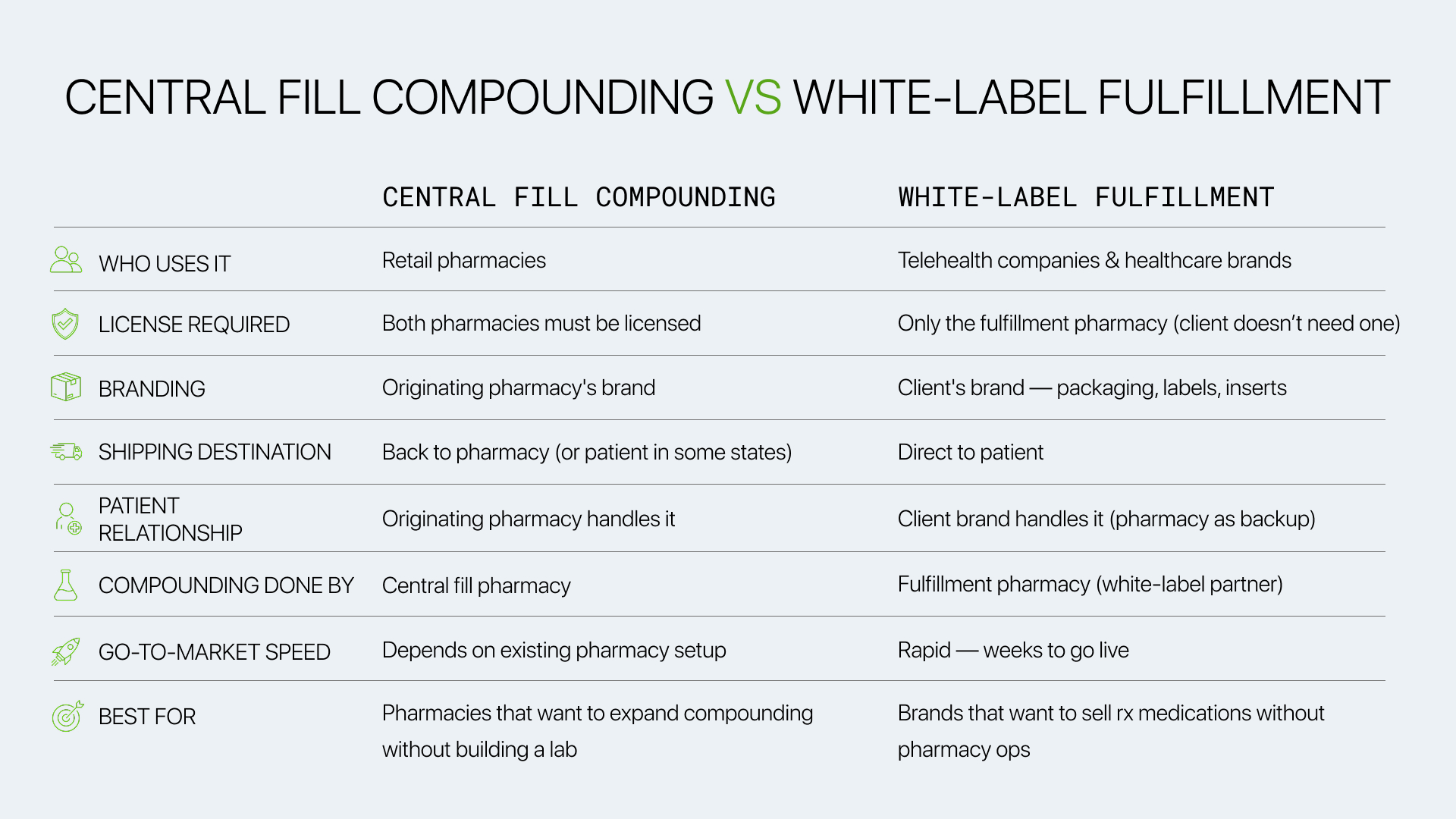
Central fill compounding and white-label pharmacy fulfillment are two distinct service models that enable pharmacies, telehealth providers, and healthcare brands to deliver prescription medications efficiently with unique advantages and operational considerations for each.
- Central fill compounding refers to a centralized compounding pharmacy preparing compounded medications on behalf of other retail pharmacies, which then dispense the medications to their patients.
- White-label pharmacy fulfillment describes a process where a licensed pharmacy handles all prescription processing, compounding, and shipping, but the entire experience (packaging, labeling, inserts) is branded with the client’s identity, such as a telehealth company or wellness brand.
Why it Matters
- Both models allow organizations to scale their prescription services without heavy investment in lab infrastructure, staff, or licensure.
- They enable faster go-to-market for new healthcare brands and improved patient access to customized therapies.
Mega Aid provides central fill compounding services for retail pharmacies and white-label fulfillment for telehealth companies, making it a leader in scalable medication solutions.
GET STARTED
Core Concepts
What is Central Fill Compounding?
Central fill compounding is a service where a specialized compounding pharmacy (the central fill pharmacy) prepares compounded medications for dispensing retail pharmacies. The originating pharmacy transmits prescriptions to the central fill, which compounds, verifies, and ships medications either back to the pharmacy or directly to patients in some states.
Example: A local retail pharmacy outsources all transdermal pain cream compounding with multiple active ingredients in custom dosages to Mega Aid, which prepares and ships the medications to the retail pharmacy quickly and compliantly.
What are the benefits for retail pharmacies:
- Enables retail pharmacies to offer custom medications without building their own compounding labs
- Gives access to extensive compounding capacity
- Reduces overhead and ensures compliance with USP and state regulations
- Allows giving the patient more services without referring to other pharmacies
Common misconception: Central fill does not mean the central fill pharmacy interacts with the patient. The originating pharmacy retains patient-facing service and responsibilities.
What is White-Label Pharmacy Fulfillment?
White-label pharmacy fulfillment allows healthcare brands (like telehealth companies) to offer prescription medications under their own brand, without owning a pharmacy license and building a lab.
The licensed pharmacy manages all operations on a backend:
- Prescription processing,
- compounding,
- packaging,
- shipping.
While the patient receives a fully branded and integrated experience under the healthcare company.
Example: A telehealth company for hair loss uses Mega Aid to fulfill all prescriptions. Medications arrive to patients in branded packaging, with inserts and support contacts that reflect the telehealth brand.
What are the benefits for telehealth brands:
- Enables rapid market entry and brand consistency
- Removes operational and compliance burdens from the healthcare brand
- Supports virtual-first care models
How Each Model Works
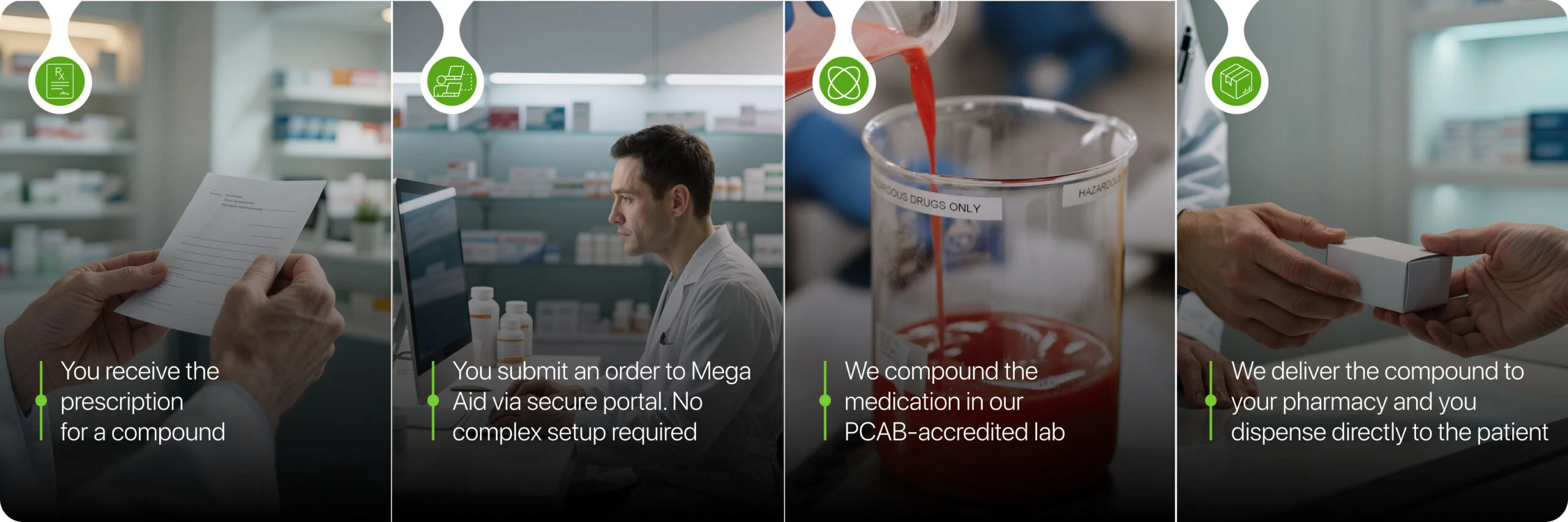
Central Fill Compounding Workflow
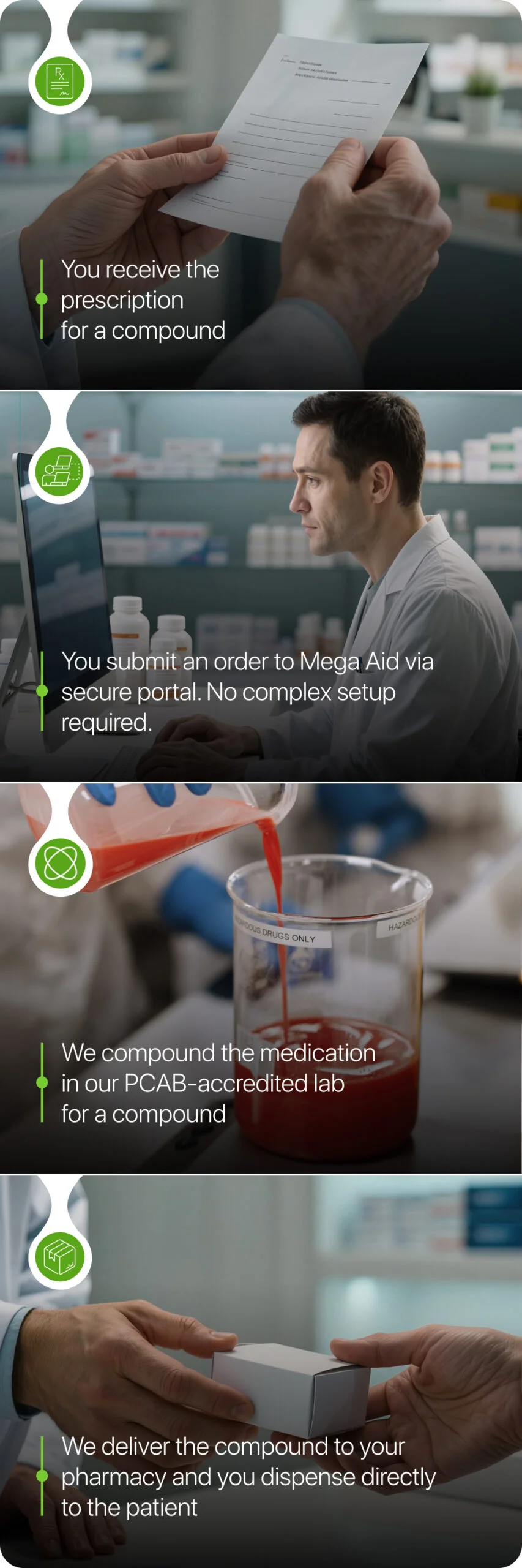
- Prescription Entry: Retail pharmacy inputs prescription into their system.
- Order submission: Prescription details are sent securely to the central fill compounding pharmacy.
- Compounding: The central fill pharmacy compounds medication according to the prescriber’s order, following USP guidelines.
- Verification & Quality Control: Pharmacists verify ingredients, dosing, and compliance.
- Shipping: Completed medication is shipped to the originating pharmacy or directly to the patient.
- Dispensing & Counseling: The retail pharmacy dispenses the medication and provides counseling.
White-Label Pharmacy Fulfillment Workflow
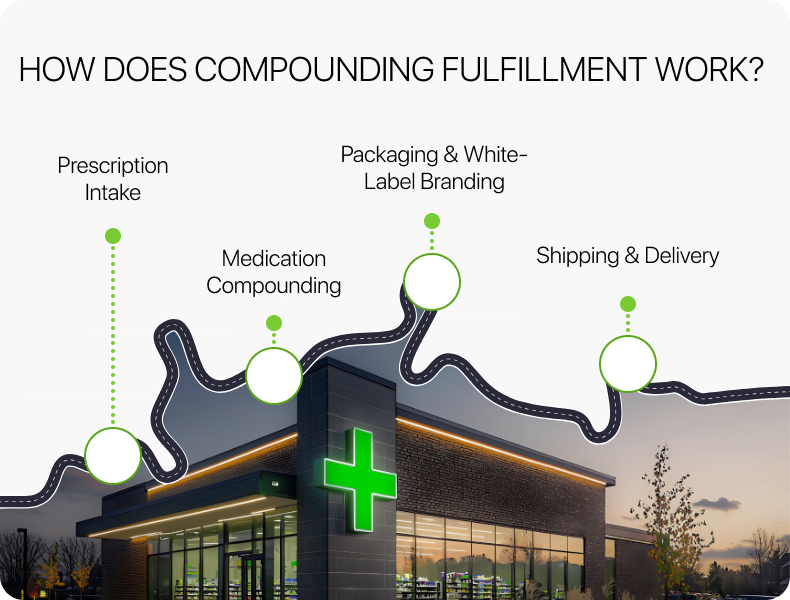
- Brand Onboarding: Telehealth or brand partner sets up workflows, branding elements, and integration with the pharmacy.
- Prescription Integration: Orders are submitted via API or secure portal.
- Branded Compounding & Fulfillment: Pharmacy compounds and packages medications with the client’s branding.
- Direct-to-Patient Shipping: Medications are shipped directly to the patient, maintaining the client’s brand experience.
- Adherence & Support: Support, refills, and communications are managed per the client’s requirements.

GET STARTED
Best Practices
Choose the Right Partner
Select a partner with appropriate accreditation (PCAB, USP 795/800), experience, and technology integration.
Ensure Compliance at Every Step
Compliance with HIPAA, state, and federal regulations is non-negotiable. Review processes regularly.
Prioritize Quality and Consistency
Central fill compounding and white-label fulfillment both require robust quality assurance, batch verification, and documentation.
Integrate Systems for Seamless Operations
APIs, secure portals, and transparent reporting reduce errors and delays.
Focus on the Patient Experience
Even in centralized or white-label models, timely delivery, clear instructions, and patient support are vital.
Monitor Outcomes
Track treatment adherence, side effects, and patient satisfaction to drive continual improvement.
Plan for Scale
Choose partners like Mega Aid with the infrastructure to grow with your business.
Clarify Branding and Patient Support
For white-label, establish clear protocols on branding, communication, and patient support escalation.
Advanced Strategies
Custom Compound Formulations:
Develop unique blends for niche therapies (e.g., hair loss, dermatology, pain, hormone therapy) via central fill or white-label.
Data Analytics Integration:
Leverage pharmacy partner’s reporting tools to monitor adherence, outcomes, and operational KPIs.
Scalable API Integration:
Use robust technical connections for real-time order status and inventory updates.
Regulatory Change Management:
Stay ahead of evolving pharmacy regulations, especially for multi-state operations.
Outcome-Based Contracting:
Align incentives with patient outcomes and satisfaction, not just volume.
Cold Chain & Specialty Logistics:
For temperature-sensitive or specialty meds, ensure your partner can support advanced logistics.
GET STARTED
Frequently Asked Questions
Q: What is the main difference between central fill compounding and white-label pharmacy fulfillment?
A: Central fill compounding prepares medications for another pharmacy to dispense, while white-label fulfillment provides end-to-end prescription services under the client’s brand, often shipping directly to the patient.
Q: Who needs a pharmacy license in each model?
A: In central fill, both pharmacies must be licensed; in white-label, the fulfillment pharmacy (e.g., Mega Aid) holds the license, and the client does not need one.
Q: Can a retail pharmacy use white-label fulfillment?
A: Typically, retail pharmacies use central fill for compounded meds, but they can use white-label for branded programs (e.g., private-label skincare lines).
Q: How does Mega Aid ensure compliance?
A: Mega Aid is PCAB-accredited, USP 795/800 compliant, and sources ingredients from FDA-registered suppliers.
Q: What medications can be compounded and fulfilled?
A: Common examples include pain creams, dermatology preparations, hormone therapies, and behavioral health blends. View specialties
Q: How long does onboarding take?
A: With Mega Aid, telehealth brands can go live in as little as a few weeks.
Q: What about custom formulations?
A: Mega Aid’s compounding lab can develop new blends to meet your needs.
Q: Who handles patient support?
A: In central fill, the originating pharmacy does; in white-label, the client brand typically does, with pharmacy support as backup.
Q: Can services scale nationally?
A: Yes, Mega Aid supports multi-state expansion for both models.
Q: What accreditations should I require?
A: PCAB, USP 795/800 compliance, and HIPAA verification are essential.
Q: How do I get started?
A: Contact Mega Aid via their central fill page or fulfillment inquiry.
- Central fill compounding and white-label pharmacy fulfillment are powerful ways to scale pharmacy operations, each suited to different organizations and needs.
- Mega Aid provides central fill compounding services for retail pharmacies and white-label fulfillment for telehealth companies, making complex medication solutions accessible and compliant.
- For retail pharmacies: Start by reviewing your compounding needs and partner with Mega Aid’s central fill team.
- For telehealth and DTC brands: Focus on rapid onboarding and brand integration through white-label fulfillment.
- For advanced organizations: Explore hybrid models, custom formulations, and robust API integrations.
Key Tools
- Mega Aid Compounding Pharmacy: Provides central fill compounding for retail pharmacies and white-label fulfillment for telehealth companies. Learn more
- API/Order Portals: For seamless, HIPAA-secure prescription transmission.
- Accreditation Databases: PCAB, ACHC, NABP for verifying pharmacy partners.
- USP Guidelines: USP 795/800 standards
Learning Resources
Communities & Further Reading